


I created the Bimini Shark Lab collection to connect wildlife photography, everyday apparel, and meaningful conservation support.
The tiger shark is one of the ocean’s most misunderstood animals. It is also an apex predator with an important role in marine ecosystems.
Through this collection, I feature real tiger shark imagery on comfortable, durable clothing. I donate 10% of profits quarterly to the Bimini Shark Lab, supporting its work to understand sharks and rays through field and laboratory research.
This article focuses on verified research and conservation information. I am not adding an invented field story or unconfirmed camera details.
Why Tiger Sharks Matter
Tiger sharks (Galeocerdo cuvier) live in tropical and warm-water coastal and oceanic ecosystems around the world. As large apex predators, they help regulate marine food webs through direct consumption and by influencing the behavior of prey species.
That role reaches far beyond a single shark or reef.
When apex predators disappear, prey populations can grow out of balance. Without sharks, prey can overpopulate, consume vital resources, damage coral reefs and seagrass beds, and eventually starve. The resulting disruption can affect global fisheries and overall ocean health.
Tiger sharks are especially important because they are highly mobile. They can move between different habitats and influence several ecosystems during their lives. Protecting them means protecting more than one location. It means understanding their movements, reproduction, behavior, and relationship with the surrounding marine environment.
The Bimini Shark Lab’s Research
The Bimini Shark Lab studies the biology of sharks and rays and the role they play in marine ecosystems. Its work spans molecular and behavioral ecology, physiology, conservation, and sensory biology.
The Lab’s tiger shark research examines residency, site fidelity, regional movement, and the use of Bimini as a potential pupping location.
Researchers use acoustic tags in young-of-year, juvenile, and mature tiger sharks. These tags are recorded when a shark comes within approximately 500 meters of an underwater receiver. The receiver array around Bimini works with collaborative arrays throughout the region, helping researchers understand how tiger sharks move across wider areas.
The research also includes longline and deepline surveys. These surveys help assess how season and location affect the catch rates of juvenile and mature tiger sharks. Stable isotope analysis can help researchers study changes in prey selection as sharks grow. Ultrasound is used to determine whether mature females are pregnant when captured around Bimini.
This is practical conservation science. Understanding where sharks go during important life stages helps researchers identify critical habitats, improve population models, develop effective regulations, and determine how populations may recover.
The Lab’s research overview includes projects covering tiger sharks, hammerheads, lemon sharks, nurse sharks, shark behavior, remote sensing, and habitat use.
Tiger Shark Apparel with a Conservation Purpose
The full Bimini Shark Lab Collection includes shark apparel and other products featuring wildlife photography. The tiger shark designs are made for people who appreciate marine life and want their clothing to communicate a clear value: healthy oceans need sharks.
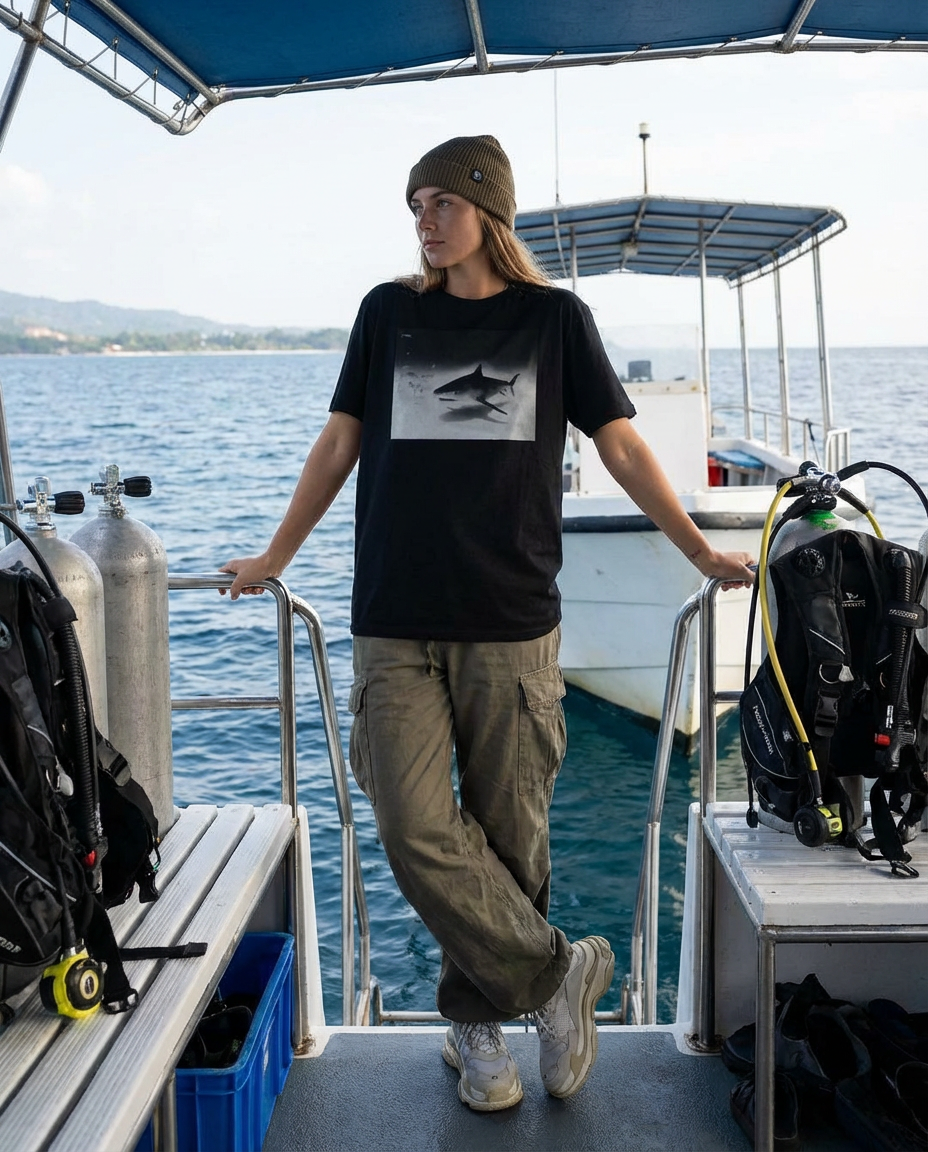
Tiger Shark Approach, Bimini Shark Labs, Moss Apparel, Cotton T-Shirt
The Tiger Shark Approach, Bimini Shark Labs, Moss Apparel, Cotton T-Shirt is a classic everyday shirt priced at $29.00.
I designed this piece around a direct tiger shark image. The shirt uses 100% cotton at 203 g/m², with a preshrunk jersey knit, a seamless twin-needle collar, taped neck and shoulders, and a tear-away label. It has a classic unisex fit and is machine washable.
SHOP THE TIGER SHARK COTTON T-SHIRT
Tiger Shark Approach, Bimini Shark Labs, Moss Apparel, Crewneck Sweatshirt
The Tiger Shark Approach, Bimini Shark Labs, Moss Apparel, Crewneck Sweatshirt is priced at $45.00 and built for cooler days, travel, and everyday layering.
The sweatshirt is made from a 50% cotton and 50% polyester blend at 203 g/m². It has a classic fit, preshrunk fleece knit, air jet yarn for a softer feel and reduced pilling, twin-needle stitching, a tear-away label, and ribbing with elastane. It is unisex and machine washable.
This is a simple, functional way to wear a powerful image while supporting shark conservation.

Tiger Shark Approach, Bimini Shark Labs, Moss Apparel, Hoodie
The Tiger Shark Approach, Bimini Shark Labs, Moss Apparel, Hoodie is priced at $55.00.
I built this design for people who want more coverage and warmth without losing the wildlife focus. The hoodie uses a 50% cotton and 50% polyester blend at 271 g/m². It features a classic fit, preshrunk fleece knit, a double-lined hood, color-matched drawcords, a pouch pocket, reinforced double-needle stitching, and ribbing with spandex.
The fabric is soft enough for daily wear and durable enough for regular use. The tiger shark photograph remains the central element.

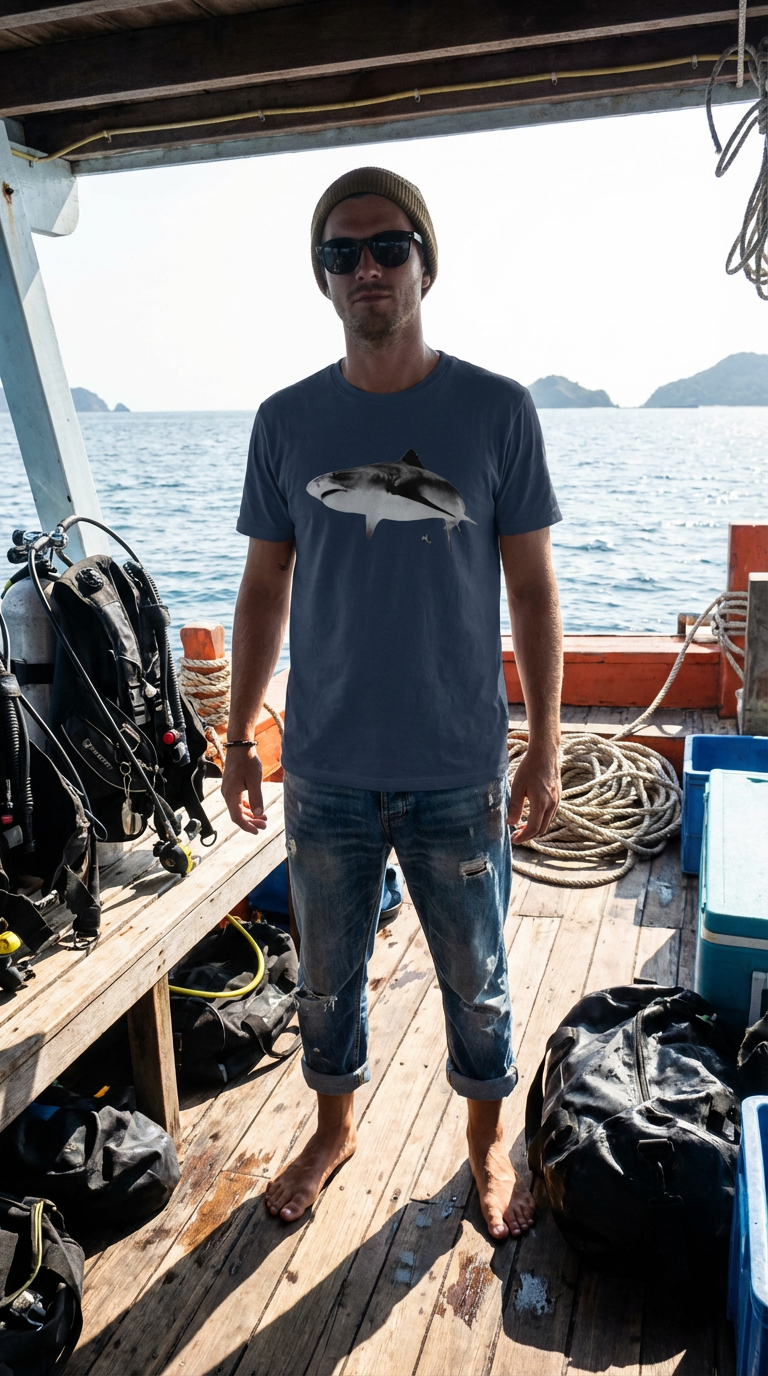
Joker the 12 ft Tiger Shark, Shark Fans, Ocean Lovers, Moss Apparel, Unisex T-Shirt
The Joker the 12 ft Tiger Shark, Shark Fans, Ocean Lovers, Moss Apparel, Unisex T-Shirt is priced at $29.00.
Joker is a named 12-foot tiger shark featured in this bold design. The shirt is made from premium Airlume combed and ring-spun cotton at 4.2 ounces, with variations in fabric composition for heather colors. It has a tailored cut, fitted sleeves, preshrunk construction, shoulder-to-shoulder taping, side seams, and a tear-away label.
It is lightweight, breathable, and easy to wear on its own or under a layer. Available sizes range from XS through 4XL, with white, black, and navy color options.
SHOP JOKER THE 12 FT TIGER SHARK T-SHIRT
Your Purchase Supports Research
When you buy from the Bimini Shark Lab collection, you are supporting a model that connects art with conservation. I donate 10% of profits quarterly from the collection to the Bimini Shark Lab.
The Bimini Shark Lab’s mission is to advance knowledge of sharks and rays, educate future scientists, share research results, and improve public awareness of sharks and other marine species. Its work provides information needed for conservation and management decisions.
The organization’s research shows why location matters. A small island environment such as Bimini can be important during key life stages, even for a species capable of traveling across large marine regions. Tracking sharks, studying their biology, and identifying areas they use for reproduction can help inform future protections.
I believe conservation apparel should do more than display an animal. It should help people understand why that animal matters.
Learn More
- Explore the Bimini Shark Lab Collection
- Visit the official Bimini Shark Lab website
- Read the Bimini Shark Lab mission statement
- Explore Bimini Shark Lab research
- Read the tiger shark research overview
@MOSSAPPAREL
Follow Moss Apparel for wildlife photography, new apparel, fine art, and conservation updates. I created Moss Apparel to help people wear their values while building a stronger connection with wildlife and wild places.
About Robert Moss
For me, nature photography begins with respect. I believe the best wildlife photographs come from observing rather than interfering, allowing an animal, landscape, or moment to exist naturally and being patient enough to capture it as it unfolds. My goal is not simply to photograph wildlife, but to create images that convey the character, beauty, scale, and vulnerability of the natural world.
I have been photographing for 10 years across North America, Central America, Southern Africa, Sri Lanka, Australia, the Caribbean, and Europe. My subjects include North American wildlife and landscapes, the American West, mountain landscapes, hawks, pronghorn, bison, deserts, coyotes, lakes, ocean landscapes, sharks, fish, underwater life, and mangroves.
From wildlife encounters to remote landscapes and underwater environments, I am drawn to moments that remind us how extraordinary the wild still is. I approach each photograph with the intention of keeping the scene authentic, preserving the natural behavior of the subject and the atmosphere of the place.
That philosophy carries through to Moss Apparel and Moss Fine Art. The photographs are not only meant to be seen; they are intended to create a greater connection with the places and species they represent. Conservation is at the heart of that mission because this approach becomes harder each year as the world changes, wildlife numbers decline, and natural spaces are threatened.
Through Moss Apparel and Moss Fine Art, I donate 10% of profits quarterly to nonprofit organizations working in wildlife conservation, habitat protection, and ocean restoration.
My hope is simple: to create photographs that bring people closer to nature while helping protect the wild places and wildlife that made those photographs possible.
Robert Moss
Founder & Photographer, Moss Apparel


